
Marriage certificates / Apostille and translation
Do I need an apostille before or after translating my marriage certificate?
The correct sequence depends on what the receiving authority requires. If it needs an apostilled marriage certificate and a translation, obtaining the apostille first can allow the translator to translate the complete document package. If authentication of the translation is required instead—or in addition—the process may differ. Confirm these requirements before ordering either service.
Introduction
When a marriage certificate is submitted abroad, the receiving authority may ask for authentication of the marriage record, a translation, or authentication connected with the translation. These are different requirements. The sequence should follow the authority’s instructions, not an assumption based on a short phrase such as “apostilled translation.”
Before ordering either service, ask the office handling your application to confirm its requirements in writing. Establish which document must be authenticated, who may translate it, and whether the apostille and other attached certifications also need translation.
What an Apostille Authenticates
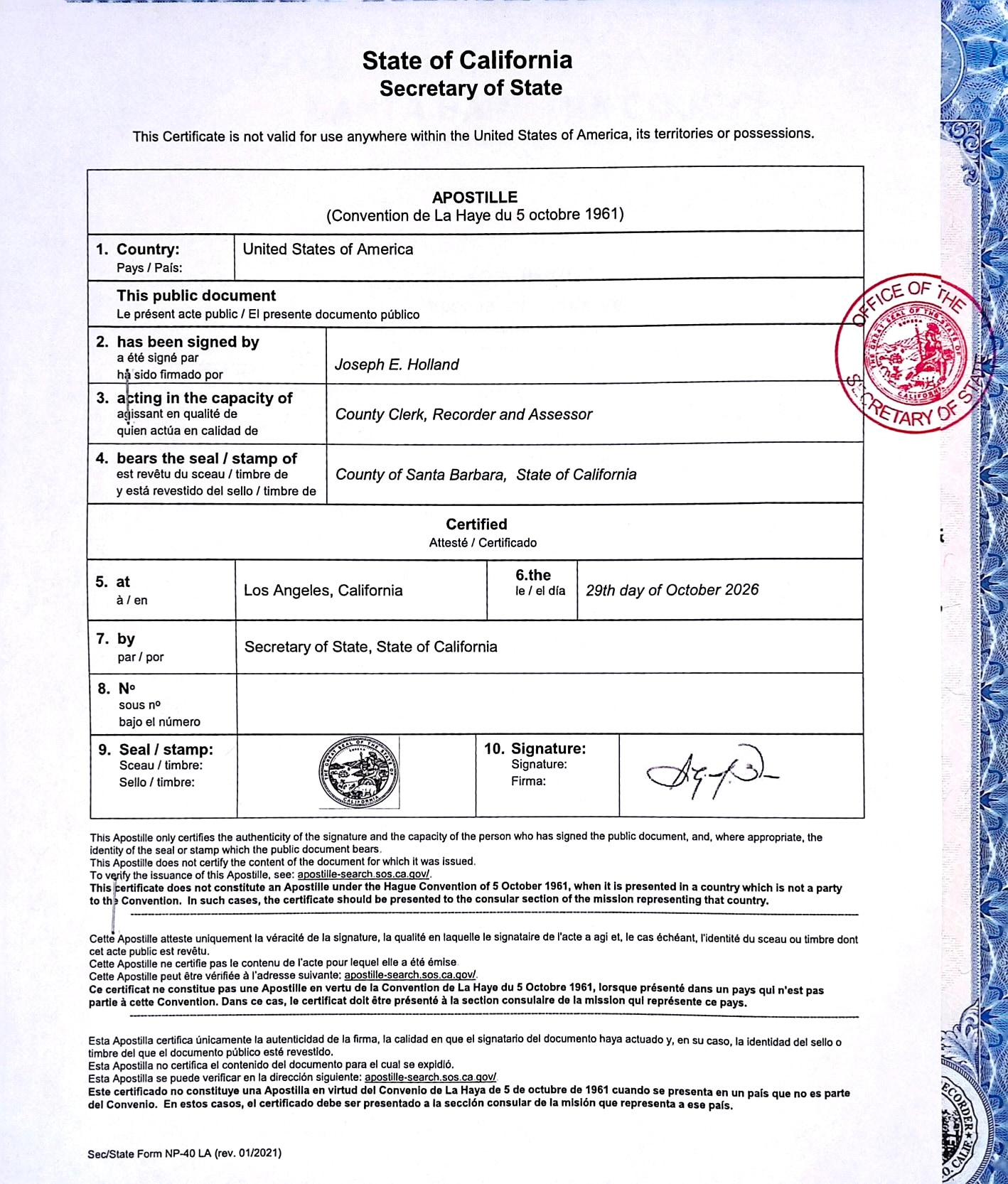
Under the Hague Apostille Convention, an apostille authenticates the signature on a public document, the capacity in which the signer acted and, where appropriate, the identity of the seal or stamp. It does not authenticate the document’s contents or certify translation accuracy. Translation and authentication therefore serve different purposes.
An apostille is issued by a designated competent authority in the place where the public document originates. The appropriate authority depends on the document type. For U.S. state or local marriage records, this commonly means the appropriate state authority, subject to that authority’s requirements. The registrar that issues a certified marriage record and the authority that issues an apostille are not necessarily the same office.
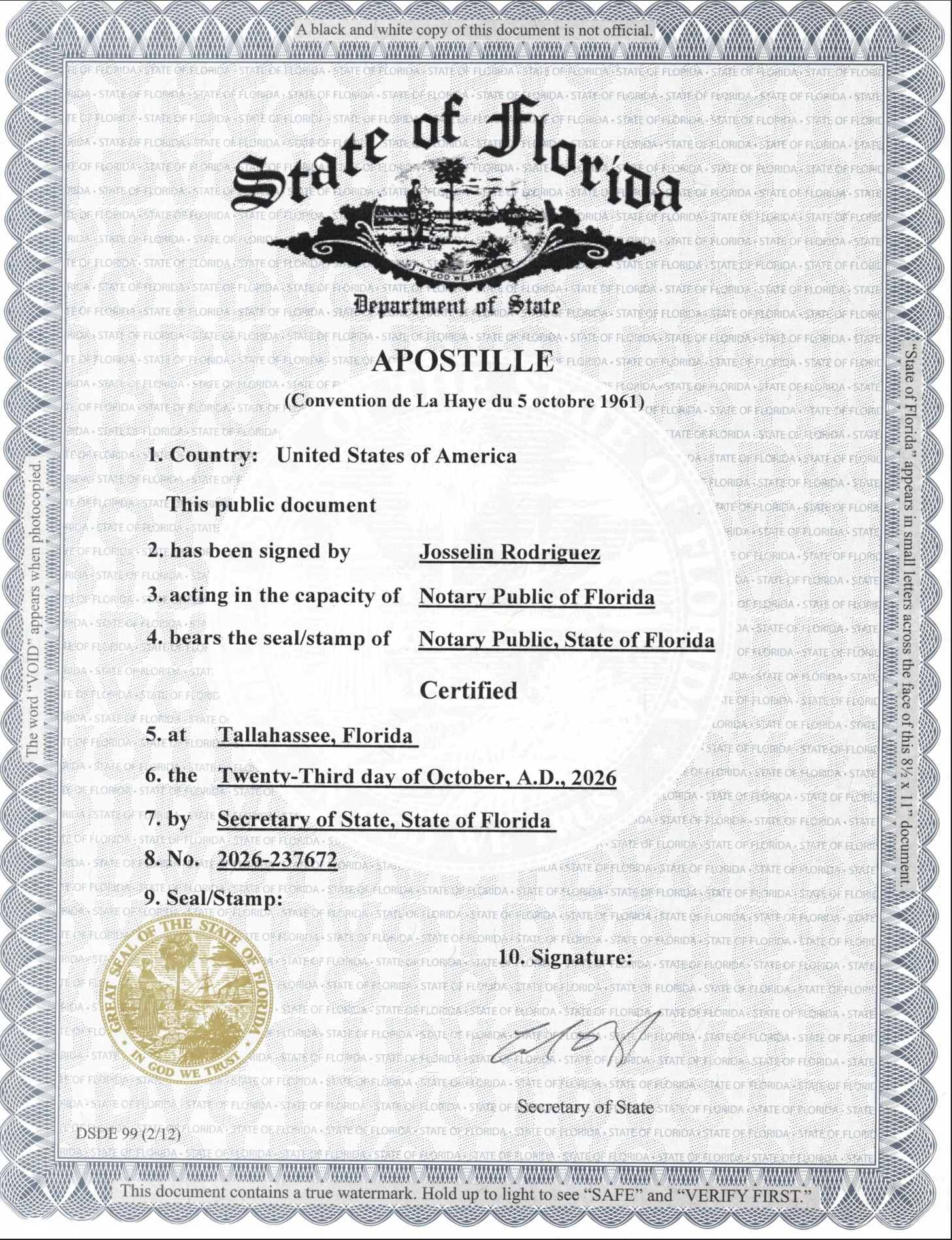
The California and Florida documents shown in this guide are illustrative examples, not blank forms for use or evidence of government endorsement. They identify different signing capacities: a county official on the California example and a notary public on the Florida example. The signature and capacity being authenticated matter; the presence of an apostille alone does not show that a particular submission requirement has been met.
When the Marriage Record Must Be Apostilled First
If the receiving authority requires an apostilled marriage certificate with a translation, begin with a certified record in the format it accepts. Check the apostille authority’s instructions as well: some records require prior certifications before an apostille can be issued. Obtain any required certifications, then request the apostille from the competent authority for that record.
Once authentication is complete, provide the translator with the entire package. Ask for translation of the marriage certificate and all other required material, including the apostille and attached certifications if the receiving authority requires them to be translated. Confirm any rules about an approved translator, certification statement, page order and delivery format.
This sequence allows the translator to include authentication pages that were not available earlier. It is a practical approach when the record itself must be apostilled, not a guarantee of acceptance and not a substitute for checking the instructions.
When the Translation Also Needs Authentication
If the authority requests authentication of the translation, first clarify what that means in the destination’s legal system. It may require a certified, sworn or authorized translator, a locally prepared translation, or another prescribed process. A translator’s certification statement, notarization and a sworn translation are not interchangeable.
Where the receiving authority accepts a route using a translator’s notarized declaration, the translation and declaration must be prepared before the relevant notarial act can be authenticated. Any apostille in that route authenticates the relevant official signature, capacity and seal, such as those of the notary; it does not certify that the translation is accurate. Follow the competent authority’s requirements for that notarial document rather than assuming that the marriage record’s apostille authority is also appropriate.
Both the marriage record and the translation-related declaration may need separate authentication. An apostille associated with a translation does not automatically replace an apostille on the marriage record. Ask for the complete sequence in writing, including whether any later authentication pages must also be translated.
Check Whether an Apostille Is the Right Procedure
Use the HCCH status table and competent-authority directory to check whether the Convention applies between the place of origin and the destination for your document. Review entry-into-force dates, any relevant objections and territorial application. A country’s appearance in the status table does not, by itself, establish that the Convention is in force for your particular situation.
Where Convention procedures do not apply, further authentication or consular legalization may be required. Other treaties, local rules or exemptions may remove or simplify authentication requirements. Confirm the applicable route with the receiving authority and, where needed, the relevant embassy or consulate before paying for services.
Your Marriage Certificate Document Checklist
Use the receiving authority’s written instructions to decide which of these items belong in your submission:
- An acceptable certified marriage record
- Confirm the issuing office, record format and any recency requirements. A newly issued copy is not required in every case.
- Required prior certifications and authentication
- Include the apostille or other authentication required for the record. Follow official instructions for keeping attached pages together.
- A translation covering all required material
- Include relevant sides, annotations, seals and attached certifications, including the apostille where required.
- The required translator’s statement or credentials
- Confirm whether certification, sworn or authorized translator status, or an accepted notarization and authentication route is required.
- Written submission instructions
- Keep confirmation of the target language, original or copy requirements, delivery method and deadline with your preparation records.
Next Steps Before You Order
- Ask the receiving authority which items need authentication: the marriage record, a translation-related declaration, or both. Request written clarification if the wording is ambiguous.
- Confirm the acceptable record format, any age limits and prior certification steps with the relevant issuing and apostille authorities.
- Check the Convention’s applicability and identify the competent authority for each document that needs an apostille.
- Confirm who may translate the documents and whether the apostille and any later authentication pages must also be translated.
- Share the written requirements and complete document package with your translation provider before agreeing to scope, price and timing.
Start with the receiving authority’s requirements, then plan authentication and translation around them. Translations First can review your files and translation instructions before you order at https://translationsfirst.com. The receiving authority determines whether your submission meets its requirements.
This guide provides general information, not legal advice. Requirements vary by jurisdiction, document and procedure; confirm current official instructions for your application.
References
These official sources explain the purpose of an apostille, Convention applicability and how to find the competent authority. California’s guidance applies to California procedures and should not be generalized to other jurisdictions.
- HCCH. Apostille Section.https://www.hcch.net/en/instruments/conventions/specialised-sections/apostille
- HCCH. Status table: Convention of 5 October 1961 Abolishing the Requirement of Legalisation for Foreign Public Documents.https://www.hcch.net/en/instruments/conventions/status-table/?cid=41
- HCCH. Competent authorities under the Apostille Convention.https://www.hcch.net/en/instruments/conventions/authorities1/?cid=41
- California Secretary of State. Apostille Frequently Asked Questions.https://www.sos.ca.gov/notary/apostille-faqs